Blog Posts
September 9, 2025
What to Expect from a Pre-Purchase Survey
Written in collaboration with Randall Boiko, S.A.M.S., A.M.S.
So you've found the perfect boat and your offer was accepted? The fun is just getting started!
For many first-time boat buyers, the period after an executed Purchase and Sale agreement can feel a bit like navigating uncharted waters. Current Yachts is here to help!
One of the most critical steps you will take during this time is the pre-purchase survey.
The pre-purchase survey is a very comprehensive review of the yacht and her systems by a marine surveyor. This survey is ordered by the prospective buyer, and is much more detailed than other surveys such as an insurance survey or a valuation survey. In addition to the hull general surveyor who will focus on the hull, it may be a good idea to also hire an engine/mechanical surveyor, whose sole purpose is to evaluate the conditions of the engine(s) and generator(s). Keep in mind that in a power vessel, most of the costly repairs are done to the engines. In a sailing vessel, both an inspection by a qualified marine mechanic and a rigging inspection may be warranted. This will depend upon the age and condition of the vessel, as well as any upgrades or deferred maintenance servicing that may be shared in damage disclosures provided by the seller prior to the survey.
Think of the pre-purchase survey as a comprehensive check-up for your potential new vessel, similar but even more detailed than a home inspection before buying a home.
At Current Yachts, we believe in empowering our buyers and sellers with clear, concise information. Let's dive into a typical yacht survey day from start to finish, giving you a clear picture of what to expect.
Why you need a marine survey
When buying a used boat, whether you are a novice or experienced boater, and especially if you have limited knowledge of boats and their systems, you will want the expertise of an independent surveyor to assess the overall cosmetic and structural condition of the vessel on your behalf. In addition, a surveyor will check to see if the boat meets all U.S. Coast Guard and ABYC (American Boat and Yacht Council) safety regulations, if its equipment works properly, and determine what needs to be fixed. The surveyor’s report will usually provide a fair market value, based on his or her search on comparative vessels (meaning, of similar type and condition).
Many marine lenders and insurance companies will require a survey before they will underwrite or insure a preowned boat or yacht.
Choosing a Surveyor
It’s essential you hire the right marine surveyor for your boat. It would be wise to talk to several surveyors before choosing one. When you do, verify their availability for the survey window spelled out in your Purchase and Sale Agreement.
Pick someone who knows about your type of boat, preferably someone credentialed by the National Association of Marine Surveyors (NAMS) or the Society of Accredited Marine Surveyors (SAMS). You may also ask the opinion of fellow boat owners you trust as well as your yacht broker.
The A-Team: Who's Who on Survey Day
Your yacht survey day will bring together a small but important crew:
- You, the Buyer: This is your investment, so be present, observe, and do not hesitate to ask questions.
-
- The Listing Broker: Represents the seller and helps facilitate logistics for the day.
-
- The Buyer-side Broker (sometimes called “Selling Broker”): You may have your own representative to assist you during the buying process if you have chosen to work with a broker. The broker will be present on the day of your survey to assist you and serve your interests.
-
- The Surveyor: The star of the show! This independent expert is your eyes and ears, thoroughly examining the vessel. As the buyer, you are responsible for hiring and paying them.
-
- The Captain: The vessel's operator, who will be running the yacht through its paces. The survey captain is chosen and hired by the seller.
-
- The Haul-out Yard: An essential component of the survey day is the boatyard that will facilitate the short-haul of your boat. You will want to have a facility that is close to the current berth of the boat under survey and one that can accommodate your type and size of boat! If you are not familiar with the area, your broker may assist you in finding an appropriate boatyard.
-
Kicking Things Off: The Cold Start & Dockside Check
Your survey day typically begins bright and early at the yacht's current berth. One of the first things your surveyor will do is inspect certain systems "cold," meaning before the engines have been started. This allows them to identify any immediate issues that might not be apparent once everything is warmed up and running.
Following these initial checks, the survey captain will be asked to start the engines. This isn't just about hearing them roar; it's about warming them up for the next crucial phase.
Hitting the Water: The Trial Run
With engines purring, it's time to cast off for the trial run (some used to call this a “sea trial”, but it’s generally not on the open sea, hence the change in terminology) – arguably the most exciting part of the day!
This is where the yacht is put through its paces on the water, allowing the surveyor and yourself to see how all systems perform under real-world conditions. During the trial run, your surveyor will systematically check all systems from bow to stern:
- Engine Performance: The captain will run the engine(s) at various RPMs and at maximum RPM to ascertain the engines are within the manufacturer’s specifications. The surveyor will assess their performance, looking out for issues such as vibrations, performance drops, leaks and identify other concerns that may arise at a later date.
-
- Navigation & Electronics: Radar, GPS, depth sounders, wind instruments – each piece of electronic equipment will be tested to ensure they are in working order.
-
- Mechanical Systems: Running lights, bilge pumps, bow and stern thrusters, generators, air conditioning, and even the watermaker will be tested. Through-hulls/seacocks (fittings that pass through the hull) will be opened and closed to check for smooth operation.
-
- Sailing Vessels: If you're eyeing a sailboat, the captain will unfurl or raise the sails. This allows the surveyor to assess the condition of the sails, looking at stitching and overall life expectancy, as well as the standing and running rigging, furling systems, clutches, and winches. In some cases, the surveyor might go up the mast, or you might choose to hire a separate rigging specialist for an even deeper assessment of the condition of the rigging.
-
The trial run is a fantastic opportunity for you to experience the vessel's handling and performance firsthand. You can ask the surveyor questions along the way, gaining invaluable insight into your potential new yacht.
Out of the Water: The Short Haul Inspection
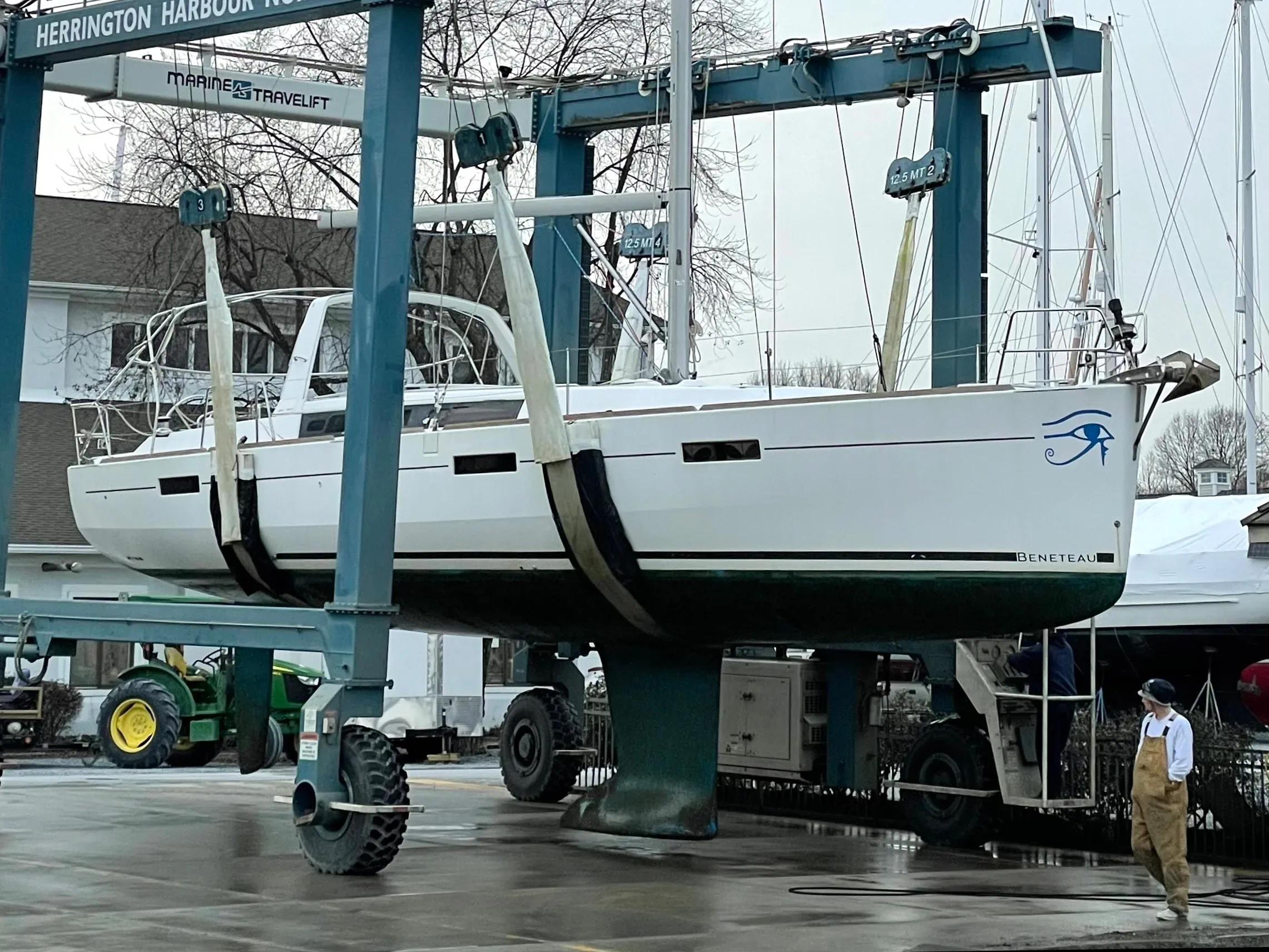
The yacht will head to a haul-out yard for what's called a “short haul”. The prospective buyer is responsible for arranging paying for this service. During a short haul, the boat is carefully lifted out of the water and held in the slings for about 30 to 60 minutes.
If it is needed, the hull will be pressure-washed to remove marine growth, giving the surveyor a clear view of the underwater surfaces.
This is where the surveyor gets down to business, inspecting:
- Running Gear: Propellers, shafts, struts, trim tabs, zincs and bearings.
-
- Through-Hulls: All the fittings that pass through the hull for water intake and discharge.
-
- Rudder & Steering: The rudder's condition and how it connects to the steering system.
-
- Drives & Seals: If applicable, stern drives, thrusters or other propulsion systems are checked for condition and leaks.
-
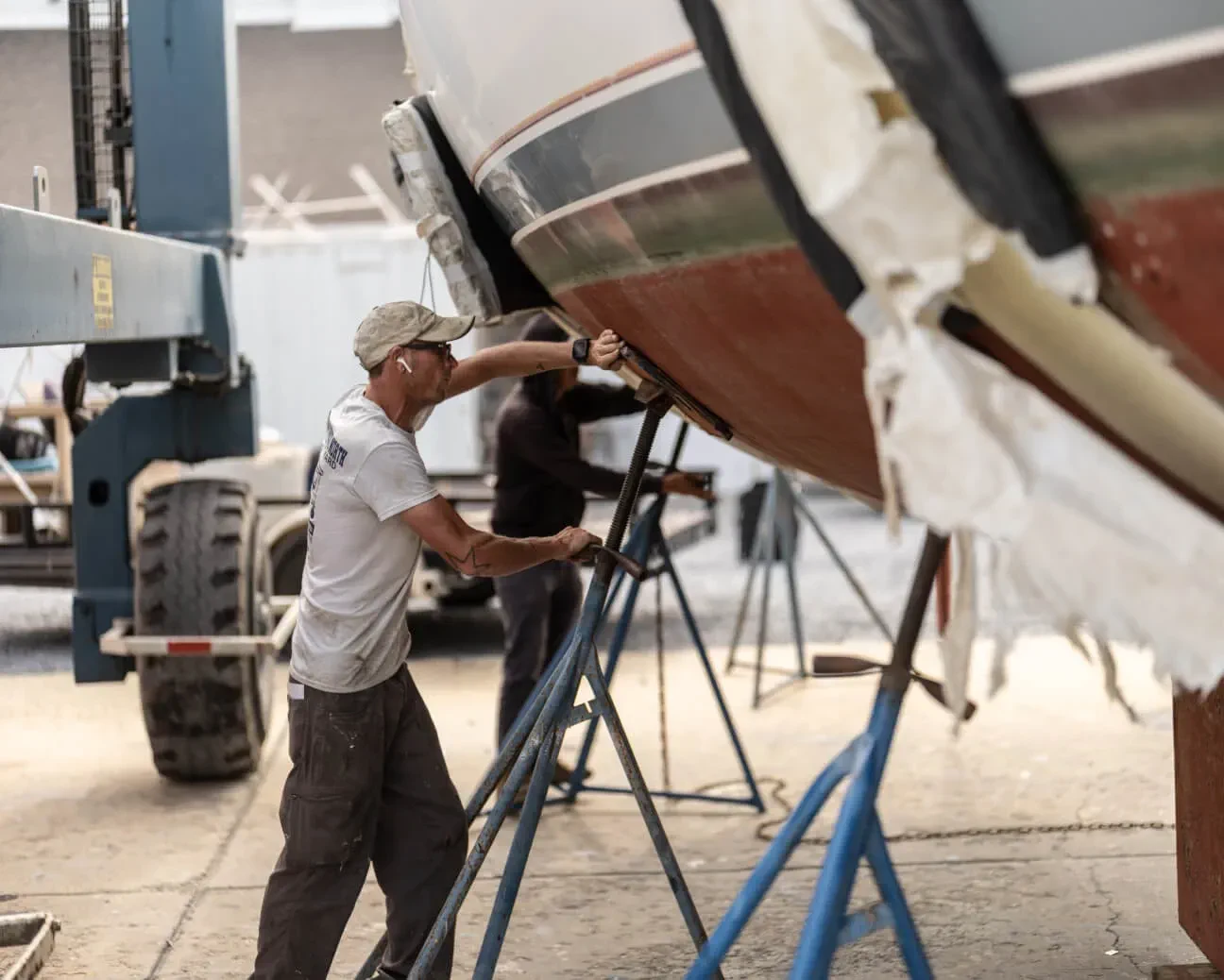
- The Bottom: Since the underside of the hull is usually bottom-painted, the short haul allows the surveyor to identify voids, delamination, blistering and any other anomalies that may be present in vessels. The surveyor inspects the underbody by the use of a small hammer which he or she uses to "sound the hull”, as well as their trained eye and many years of experience inspecting boats. The surveyor will also examine the condition and useful life of the antifouling paint.
-
Once these crucial checks are complete, the yacht is immediately "splashed" back into the water.
Cost of a Survey
The cost of a pre-purchase marine survey can vary greatly, typically from $20 to $35 per foot of boat length. The wide range in costs can be explained by multiple factors such as geographic location, vessel size, type and complexity, and the individual surveyor's experience and rates.
Travel expenses are another consideration, with surveyors commonly charging mileage rates for distances beyond their local service area. Further travel expenses may apply if your chosen surveyor travels by air to a more distant location like the Caribbean. This should also be factored into your budget.
Additional expenses can quickly add up beyond the base survey fee.
- Haul-out costs typically range from $10-15 per foot depending on boat size and marina location, which is often required for a thorough hull inspection.
-
- System-specific inspections such as engine surveys, electrical assessments, or rigging evaluations may incur separate fees. To better estimate these services, it is recommended you consult your broker.
-
Finally, your own expenses to attend the trial run may include fuel costs or airfare, and potential overnight accommodations. When planning for a comprehensive pre-purchase survey, it's wise to budget 20-30% above the base survey cost to account for these additional expenses.
The Verdict: Verbal Assessment & Formal Report
A full survey day is just that – a full day! By the end, you will likely feel a mix of excitement and anticipation. At the end of the survey day, your surveyor will typically provide you with a verbal assessment of their findings while everything is fresh in everyone's minds. This is an excellent opportunity to discuss any immediate concerns or observations.
Within a few days to a week (depending on your chosen surveyor), you will receive a comprehensive written report. This detailed document will outline all the surveyor's findings, including any deficiencies or recommendations, and will often include a valuation of the vessel. Don’t be shocked if the initial list of deficiencies runs quite long, this is completely normal!
The surveyor’s recommendations are usually prioritized, for example:
- Must-fix items: Safety issues that need immediate attention, like fuel system problems or structural damage. These often lead to price negotiations.
-
- Should-fix items: Problems that need fixing but are not immediate safety concerns, like electrical issues or minor repairs.
-
- Nice-to-fix items: Optional upgrades that would make the boat better, like new electronics or cosmetic improvements.
-
The pre-purchase survey is a crucial step in your buying journey, providing you with the peace of mind and detailed information you need to make an informed decision. This report will help you decide to “Accept or Reject” the vessel. It also gives the opportunity for further negotiations upon the currently agreed upon purchase price.
Find suggestions of surveyors on our Marine Directory. With Current Yachts, you are never sailing alone – we are here to guide you every nautical mile of the way.
Want to learn more about marine surveys? Watch episode 4 of the Full Displacement Podcast and episode 27 of the Full Displacement Podcast.